
The OROOK 2026 Salary report delivers one of the most detailed benchmarks for specialised AEC subcontractors across Serbia, UAE, Hungary, Romania and Türkiye.
For the first time, beyond standard roles, a custom benchmark option was introduced, allowing companies to define and analyse their own critical positions, as well as non-standard roles and company-specific hybrid positions.
The report was based on 3,250+ survey responses, 93 in-depth expert interviews, OROOK’s direct recruitment evidence as well as structured validation across five markets. Instead of making yet another generic compensation overview, OROOK prepared a subcontractor-focused benchmark, designed for companies delivering complex projects under margin pressure and talent scarcity.
For companies: Why this report matters
Beyond salary benchmarking, the OROOK 2026 Engineering & Managers Salary Survey provides companies with a practical decision-making tool for managing compensation, retention and international workforce planning.
For the first time, companies can also include custom roles tailored to their specific organisational structures, enabling benchmarking for hybrid or company-specific positions that are typically absent from standard AEC compensation reports. This makes the survey particularly relevant for specialised contractors operating with non-standard technical, operational or commercial roles.
Additional markets or roles can also be covered upon request, allowing multinational contractors and specialised subcontractors to build consistent salary benchmarks across their entire regional footprint.
For companies operating in complex project environments, the report provides structured insight into salary positioning, expectation gaps, and cross-market competitiveness, helping leadership teams make better-informed decisions on recruitment, retention strategies and compensation structures.
For detailed, company-oriented insights (10+ pages per country), cross-market tables, executive breakdowns, and custom position analysis, contact us at:
📩 contact@orook.net
For engineers & other professionals in AEC market
OROOK now offers a free country summary for professionals. Simply write to us and request your own free copy.
If you haven’t already:
What makes this report different?
OROOK’s 2026 Salary report enables in-depth cross-market positioning. Whether you operate regionally or internationally, you can see where salary curves accelerate, where expectation gaps widen or where retention risks are highest.
The report is analysing the following roles (actual vs. expected net monthly base salaries): CEO (subcontractor scale: €5–20M turnover), QSE Manager, Finance Manager, Business Developer, Project Manager, Construction Manager, Site Engineer and Superintendent. Each role is segmented by Junior, Medior and Senior positions.
The critical pressure zone: Medior level
Across all five markets, one pattern is undeniable: The steepest salary progression happens at medior level. This is the moment when engineers move from execution support to independent delivery, client communication, commercial responsibility and site leadership.
This transition creates 10-18% expectation gaps, high dispersion risk, as well as strong cross-border mobility. For subcontractors, this is the most sensitive retention segment.
Country Highlights
Serbia – Rising expectations amid talent shortages
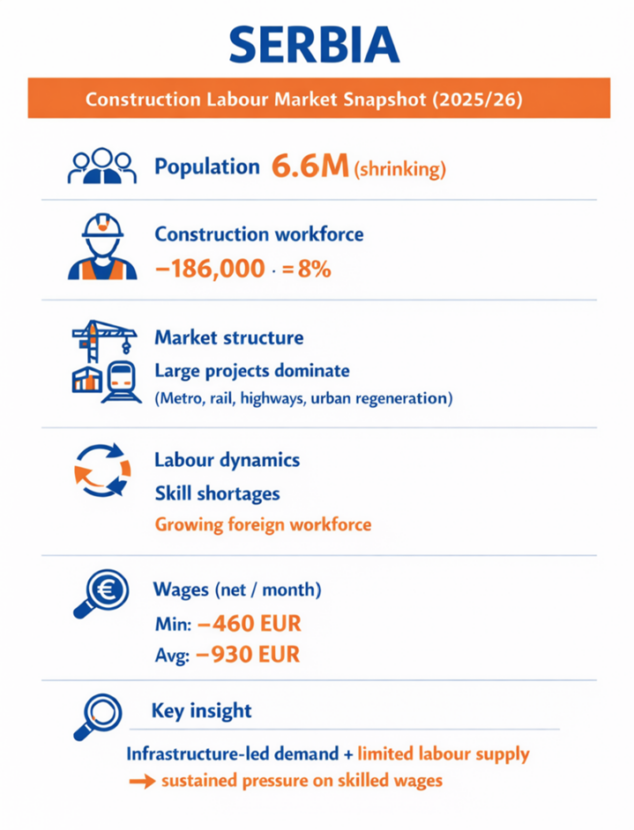
Serbia’s construction market is growing but is increasingly strained, driven by large public and PPP infrastructure projects, and major highway corridors that are concentrating demand for skilled labour. With around 186,000 workers in the sector, persistent labour shortages partly offset by foreign hires, rising material costs and inflation continue to pressure margins. Still, strong residential and commercial development alongside opportunities in sustainable and energy-efficient construction support the industry’s long-term potential.
Key Indicators:
Salaries in Serbia’s construction market rise steeply with experience, reflecting strong demand and limited senior talent. Junior engineers and managers typically start between €900–1,300 net, but by medior level earnings move into the €1,500-2,500 range, while senior Project and Construction Managers commonly reach €2,500-3,000, with expectations running about 20% higher, especially on complex or politically sensitive projects. Executive roles show a similar gap: CEOs currently earn around €3,500-4,500 net (with expectations above €5,000), while Financial Managers average €2,500-3,500, underscoring both market competition and upward pressure on pay across the sector.
Romania – Rising pay and emerging challenges
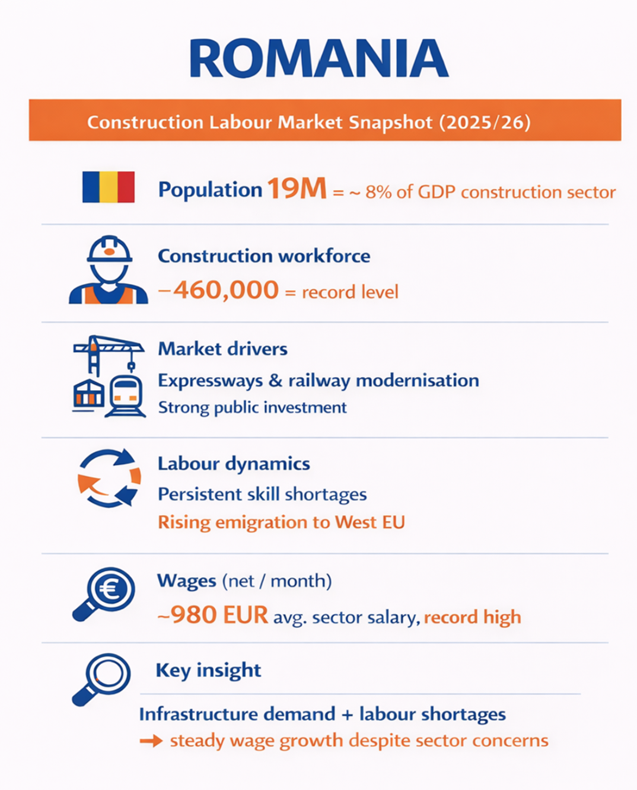
Romania’s construction sector remains one of the country’s key growth engines, driven by massive public infrastructure investment, including hundreds of kilometres of expressways and major railway modernisation, which has pushed output and GDP contribution to multi-year highs. With around 460,000 workers and average net salaries nearing €980, labour shortages continue to fuel wage growth, particularly in civil and industrial infrastructure. On the other hand, slowing private residential development, rising material and labour costs, and mounting fiscal pressures are beginning to test contractor confidence and long-term stability.
Key Indicators:
Salaries in Romania’s construction market show a clear upward trajectory across experience levels, with a consistent premium for Construction Managers and commercially oriented roles. Junior professionals typically earn €1,000-2,000 net, while medior PMs and CMs move into the €2,000-3,000 range, and senior managers commonly exceed €3,000, many expecting €4,000+ with actual pay trailing slightly behind expectations. Business Development and executive roles command the highest upside, as CEOs in subcontracting firms benchmark around €4,000-5,500 net and Financial Managers average €3,000-4,000, highlighting strong competition for leadership and revenue-driving talent.
Hungary – Structured and predictable market
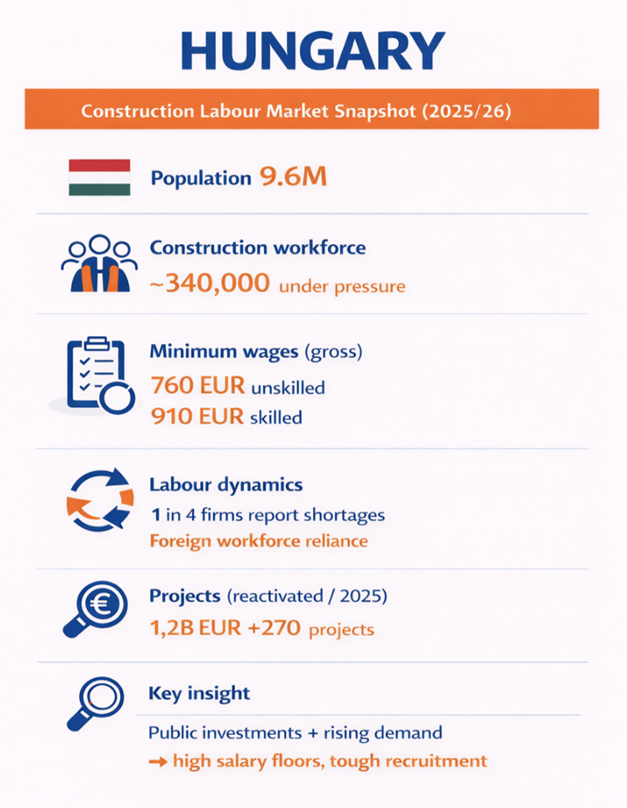
Hungary’s construction sector is navigating a period of adjustment, with employment softening after recent contraction but signs of recovery emerging through the reactivation of more than €1.2 billion in public infrastructure projects. While nearly one in four firms reports labour shortages, particularly in skilled trades, wage floors of €760 gross for unskilled and €910 gross for skilled workers set the baseline in a market where actual pay often runs higher. With residential activity subdued but state-backed transport, utility, and energy-efficiency projects gaining momentum, the sector is positioning for a gradual rebound from 2026 onward.
Key Indicators:
Salaries in Hungary’s construction market follow a structured, experience-driven progression, with clear premiums for senior leadership and revenue-linked roles. Junior professionals typically earn €1,000-2,500 net, while medior Project and Construction Managers cluster around €2,200-2,700 actual pay, rising to €3,000-3,500+ at senior level, with expectations consistently above realised salaries. Business Development and executive positions show the strongest upside – senior BD Managers often exceeding €4,000 in expectations, CEOs benchmarking €4,500-6,000+ net, and Financial Managers averaging €2,800-3,700, highlighting a competitive market where commercial impact and organisational complexity drive compensation.
Türkiye – Fast-moving, inflation-driven market
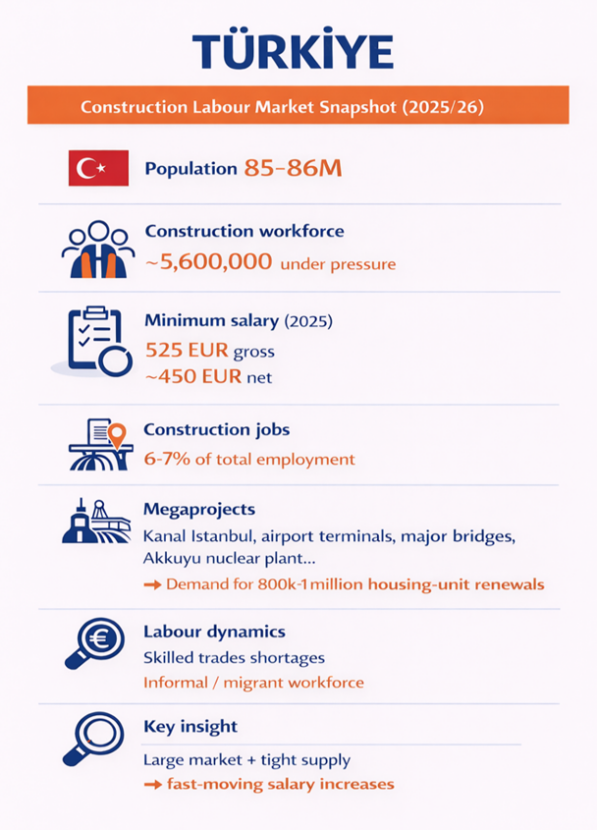
Türkiye’s construction market is one of the region’s largest and most dynamic, fuelled by megaprojects, transport and energy investments, and an immense urban-transformation and post-earthquake reconstruction agenda. With construction employing around 6-7% of the workforce, demand for skilled trades, certified seismic specialists, and experienced project managers remains structurally high, even as labour shortages and migration policies create volatility. Against a backdrop of inflation and currency fluctuations, salaries, particularly for technical and managerial roles, remain fluid and highly responsive to project demand and talent scarcity.
Key Indicators:
Türkiye’s construction salary landscape sits above Central and Eastern Europe in absolute terms but is marked by pronounced expectation gaps driven by inflation, megaproject intensity, and high labour mobility. Junior managers already expect €2,300-2,500 net on average (with many benchmarking above €3,000), while medior and senior Project and Construction Managers commonly expect €3,000-4,000+, outpacing actual pay by 10-25% across most roles. Executive benchmarks are similarly elevated – CEOs often expecting €6,500+ and Financial Managers around €4,000, yet actual salaries remain more conservative, underscoring a fast-moving market where expectations adjust more quickly than subcontractor margins.
UAE – Global premium benchmark
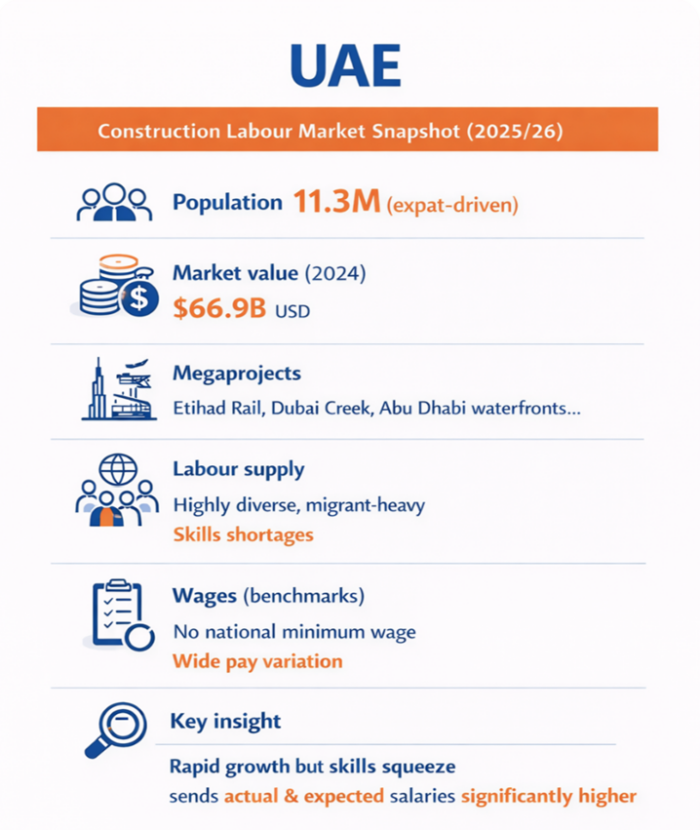
The UAE stands clearly above all other analysed markets. The construction sector is a mid-sized but fast-growing market, projected to reach USD 96.06 billion by 2030. Growth is driven by major public and private megaprojects, alongside continued investment in tourism, logistics, ports, airports, and renewable energy infrastructure. While the outlook remains expansionary, the sector faces persistent skilled-labour shortages, rising wage pressure, and wide salary variations shaped by its highly expatriate, multinational workforce and fully market-driven pay structure.
Key Indicators:
Salaries in the construction sector of the UAE are significantly higher than in Serbia and other Central/Eastern European markets, with actual pay typically 1.5-2x higher across most roles and even stronger premiums at senior level. Junior managers already start from elevated amounts (roughly €2,300-3,300 actual), while senior Project Managers frequently earn €5,000-6,000 with expectations reaching €7,000 or more; executive roles such as CEOs range from €8,000-10,000 actual with expectations above €10,000. Across all seniority levels, expected salaries consistently exceed current pay, by around 8–12% at junior level, rising to 18-25% at senior level. Overall, the UAE market is characterised by steep salary curves, strong differentiation driven by nationality and project type, and a substantial premium for GCC experience.
Cross-Market Insights
The conclusions across all five markets are clear:
- Junior expectation vs. actual salary gap: 5–10%
- Medior gap: 10–15%
- Senior gap: 15–25%
- Construction Managers frequently match or exceed PM salaries
- Business Development shows senior-level premium
- CEO compensation is strongly tied to complexity and international exposure
For more detailed, company oriented insights with possibility of covering other positions, please get in touch via contact@orook.net, and, if you haven’t so far, don’t forget to register on our platform, as well as follow our blog and our Linkedin.